

Table of Contents
Through 2026, India’s banking, financial services, and insurance sector has been in a phase of experimentation with AI. Institutions adopted generative AI at pace, tested plug-and-play solutions such as voice AI for collections and copilots for employees and built an understanding of the value the technology could create. 2027 onwards needs to be the year of AI industrialization, in which institutions convert that understanding into enterprise-wide, measurable, and governed impact.
India’s financial institutions are better positioned to make this shift. A sovereign AI stack is taking shape, with Indian language models, infrastructure, and talent built for the Indian context. The broader ecosystem has deepened across models, platforms, and specialized skills. Regulators are introducing new frameworks, such as RBI’s FREE-AI and SEBI’s proposed AI/ML guidelines, that will crystallize expectations on the responsible use of AI in financial services.
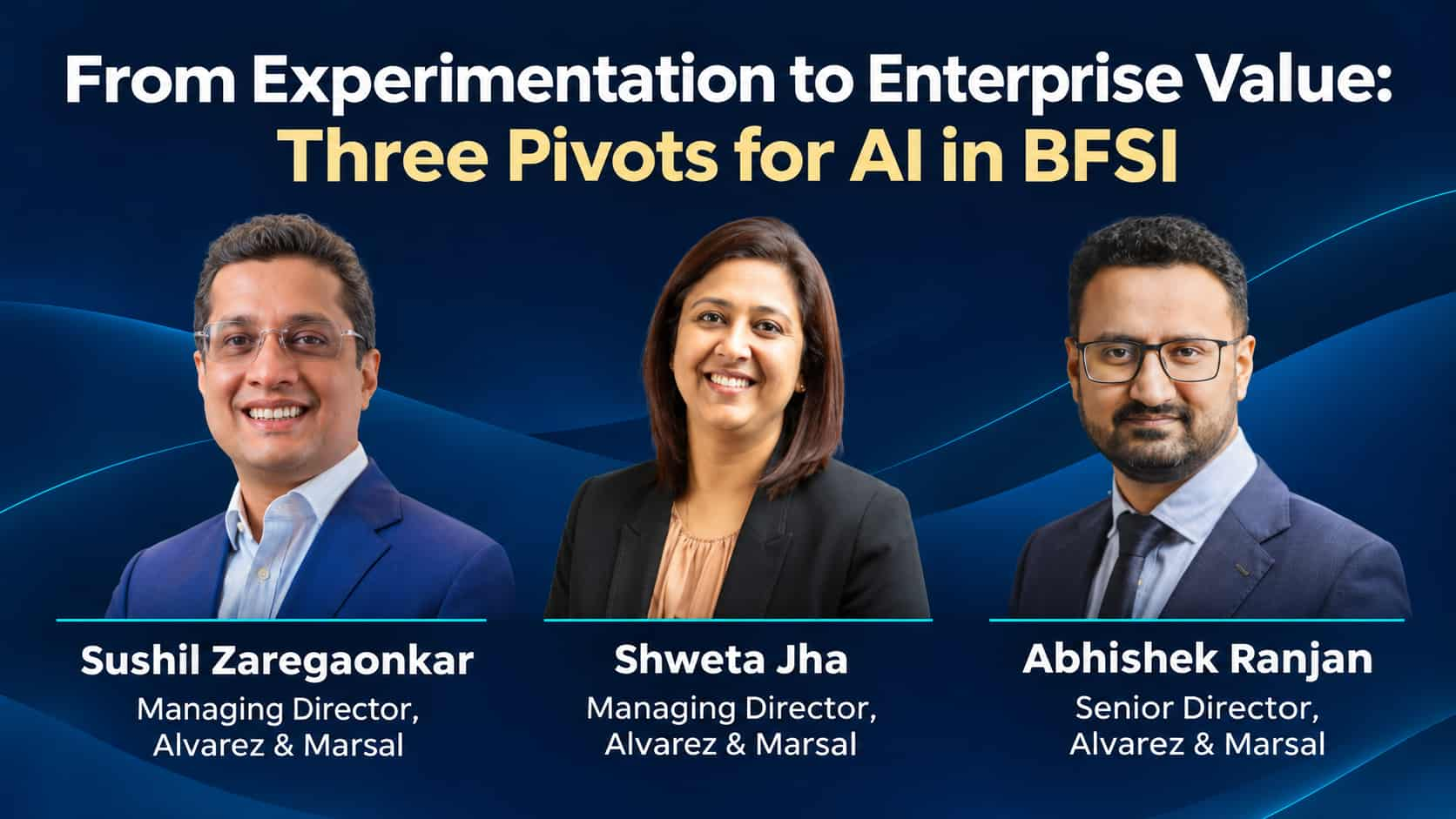
From our vantage point, supporting banking, financial services, and insurance (BFSI) leaders across multiple AI programs, we see three strategic pivots that will separate the institutions that scale AI from those that remain in pilot mode.
1. The Value Pivot: From Vanity Metrics to Enterprise Value
AI should be measured by the outcomes it delivers, not the activity it generates. Leading institutions are moving from isolated use cases to the re-imagination of end-to-end domains. Each domain is anchored to a small set of business outcomes, with a baseline set before deployment and a business owner accountable for delivery.
Licences deployed, tokens consumed, and calls made show that adoption is happening, but they say little about returns, and in our experience, boards are now asking for returns. Isolated use cases also rarely move the P&L, because value sits in how workflows across a domain rather than in any single step.
2. The Economic Pivot: From Point Solutions to Shared Foundations
Sustainable AI economics require foundations that are built once and reused across the enterprise. Three choices matter most. First, an enterprise AI platform on which all business units build, such as a common AI harness, the layer of orchestration, context, evaluation, and guardrails within which models operate. Second, an optimized choice of models, matching each task to the most cost-effective option, including open-source models, and integrating the sovereign AI stack, such as small language models, where it fits. Third, reusable, AI-ready data products that new use cases draw on rather than rebuild.
Focus on building foundations is critical as the unit cost of tokens continues to decline, yet the total cost of AI is rising. Agentic workflows consume far greater token volumes, and every point solution brings its own vendor, integration, and data pipeline. Without shared foundations, cost rises in step with ambition. With them, each successive use case should be faster and cheaper to deliver than the last.
3. The Trust Pivot: From Policy-Led to Architecture-Led Governance
Trust is a precondition for scale, and governance must be embedded in the architecture rather than defined only in policy. Four core principles need to be institutionalized. Transparency, through a complete inventory of models and their uses. Traceability, through audit trails of inputs, outputs, and decisions. Accountability, through clear ownership across the three lines of defense and human oversight of high-impact decisions. Control, through continuous monitoring and the ability to override or withdraw a model. Capability remains the binding constraint. In our experience, AI fluency is widespread, but depth in engineering, model validation, and audit is scarce, and building that depth matters as much as building the technology.
The sector also needs to be cognizant of Digital Personal Data Protection (DPDP), personally identifiable information (PII) protection, and related regulations, including data residency and where models are hosted. To address this, frontier AI companies and hyperscalers are increasingly tailoring their products for India.
Translating the Pivots into a Roadmap
These pivots change how value is measured and how investment is sequenced. Value should be tracked across productivity, operational efficiency, customer outcomes, and risk management. We strongly believe AI investments should follow an invest-as-you-grow approach: prioritize two or three high-value domains, build only the foundations they require, and reinvest the value realized to extend the platform for the domains that follow.
For BFSI leaders, three questions can test the strength of the 2027 AI agenda. Which domains will deliver measurable P&L impact in the next 12 months? How much of what is being built will be reused across the enterprise? And can every AI-enabled decision be explained to customers, auditors, and regulators?
There is a parallel with the digitization era, when institutions faced similar build-versus-buy dilemmas until mature SaaS offerings resolved much of the decision paralysis. The AI landscape is evolving rapidly, and a key question is whether a similar productization of AI is under way, with enterprise-grade solutions that will simplify adoption. Institutions that make the three pivots now should be well placed whichever way it unfolds.
Disclaimer: This article is based on publicly available information, market analysis, and the authors’ professional experience and work. For questions regarding the underlying sources or analytical methodologies, please reach out to the author directly. The analysis reflects market trends and observations and is intended for general informational purposes only. It does not constitute investment, legal, or financial advice.